


TMJ Has Never Been Just a Jaw Problem

"The doctor of the future will give no medicine, but will interest his patients in the care of the human frame, in diet, and in the cause and prevention of disease." — Thomas Edison
The Problem Rarely Starts Where It Hurts
The temporomandibular joint rarely announces itself as the source of the problem. What it produces instead is a collection of symptoms that scatter in every direction — headaches, ear pressure, neck stiffness, shoulder tension, tinnitus — sending patients through a series of specialists who each address their piece of the picture without anyone stepping back to see the whole. The jaw, sitting at the center of all of it, goes unexamined, because it has long been understood as a dental problem contained within the mouth, separate from everything above and below it. The anatomy tells a very different story.
The TMJ is one of the most used joints in the entire body, active every time you speak, chew, swallow, or express any emotion at all. It sits at the precise intersection of the jaw, the skull, and the upper cervical spine, and when it is not functioning well, the effects travel — up into the head, down into the neck, across the shoulders, and further still. Understanding why requires understanding the anatomy, and the anatomy, once you see it clearly, makes the whole-body connection impossible to ignore.
The Atlas Holds Everything
The cervical spine begins at the base of the skull and descends into the neck. Its uppermost three vertebrae — C1, C2, and C3 — sit directly behind the jaw, at the precise point where the skull meets the neck.
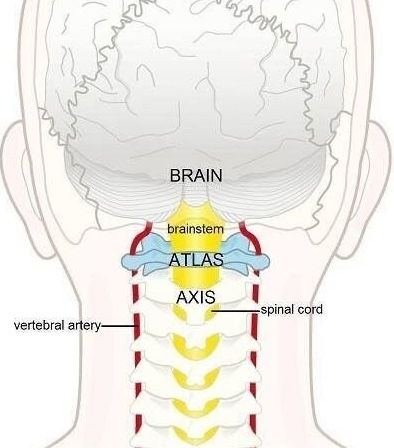
C1, known as the Atlas, takes its name from the Greek Titan who held the world on his shoulders. The Atlas is the only vertebra that articulates directly with the skull, supporting the entire weight of the head — approximately ten to twelve pounds — on a surface roughly the size of a ring, and it governs the nodding motion of the head, the simple forward and backward movement that happens dozens of times in every conversation. C2, the Axis, is the pivot on which the head rotates from side to side. C3 bridges the upper cervical spine with the structures below. Neither C1 nor C2 has an intervertebral disc, which gives the upper cervical spine its extraordinary range of motion and also makes it uniquely vulnerable to the sustained tension that jaw dysfunction creates.
The TMJ and C1 are not merely neighbors — they are functionally inseparable. Both articulate with the temporal bone of the skull, both are influenced by the same muscles: the sternocleidomastoid, the trapezius, the suboccipital muscles at the base of the skull. Both are served by the trigeminal nerve, one of the largest cranial nerves in the body, which connects the jaw directly to the brain and upper cervical nervous system. The relationship runs in both directions without exception. An inflamed or misaligned TMJ will always affect C1 — altering muscle tone, changing the position of the skull on the atlas, creating asymmetric loading that the upper cervical spine must continuously compensate for. A misaligned C1, even by as little as one to two millimeters, will tilt the skull and place uneven pressure on the TMJ, compressing the joint space on one side while stretching it on the other, disrupting the disc, and generating the clicking, aching, and restricted movement that patients often assume is a purely dental problem. In upper cervical medicine, the TMJ is sometimes referred to as the C0 vertebra precisely because of how intimately it functions as part of the cervical chain rather than apart from it.
What makes the atlas particularly consequential, beyond its relationship to the jaw, is what passes through and around it. The brainstem — the structure that governs the most fundamental functions of life, including breathing, heart rate, and consciousness — passes directly through the atlas. The vagus nerve, the longest cranial nerve in the body and the primary regulator of the parasympathetic nervous system, originates at the brainstem and runs directly in front of the C1- C2 joint as it descends through the neck toward the heart, lungs, and digestive system. The vagus nerve is what allows the body to shift out of fight-or-flight and into the rest-and-recovery state in which healing, digestion, immune regulation, and emotional balance all depend. When C1 is misaligned — as it will be when the TMJ is chronically inflamed — it can compress or irritate the vagus nerve, disrupting that shift. The body becomes stuck in a stress state it cannot fully exit. Digestion slows. Heart rate variability decreases. Inflammation becomes harder to regulate. Fatigue becomes chronic. None of these symptoms point obviously to the jaw, and yet the jaw, through its relationship with C1 and the vagus nerve it displaces, may be at the origin of all of them.

The relationship runs in both directions without exception. An inflamed or misaligned TMJ will always affect C1 — altering muscle tone, changing the position of the skull on the atlas, creating asymmetric loading that the upper cervical spine must continuously compensate for. A misaligned C1, even by as little as one to two millimeters, will tilt the skull and place uneven pressure on the TMJ, compressing the joint space on one side while stretching it on the other, disrupting the disc, and generating the clicking, aching, and restricted movement that patients often assume is a purely dental problem. In upper cervical medicine, the TMJ is sometimes referred to as the C0 vertebra precisely because of how intimately it functions as part of the cervical chain rather than apart from it.
Why TMJ Symptoms Travel So Far

No discussion of this connection is complete without the trigeminal nerve — the fifth cranial nerve, and one of the most expansive neural networks in the human body. The trigeminal nerve carries sensory information from virtually the entire face: the teeth, the gums, the jaw, the sinuses, the forehead, the temples, and the ears. It also shares reflex connections with the upper cervical nerves at C1, C2, and C3, meaning that pain or inflammation at the TMJ can be interpreted by the nervous system as originating almost anywhere within this vast territory. This is why TMJ dysfunction produces symptoms that seem to have nothing to do with the jaw — tinnitus driven by TMJ inflammation triggering the trigeminal nerve's connections to the ear, chronic headaches generated by sustained muscular tension in the jaw and neck activating trigeminal pain pathways, and facial pain or sinus pressure that most patients would never connect to a joint in front of their ears.
Atlas misalignment compounds this further. When C1 shifts — as it will when the jaw is chronically inflamed or misaligned — it can compress the vertebral arteries that run through the cervical vertebrae, reducing blood flow to both the brain and the TMJ region, with downstream effects that can include dizziness, cognitive fogginess, and fatigue that patients frequently attribute to stress, poor sleep, or aging.
Posture, Chronic Tension, and the Full Body
The relationship between the TMJ and the cervical spine does not stop at the neck. Forward head posture — the position most adults adopt for significant portions of the day, at a desk, at a screen, in a car — shifts the head forward over the shoulders, increasing the load on the cervical spine and compressing the TMJ simultaneously. For every inch the head moves forward of its natural position over the spine, the effective weight it places on the neck muscles increases by approximately ten pounds, and the jaw, responding to the altered head position, shifts backward into a compressed resting position while the muscles of the jaw and neck begin to overwork.

The fascial system, which wraps and connects every muscle, bone, and organ in the body, transmits this tension downward. Chronic TMJ dysfunction and the cervical tension it generates can alter shoulder mechanics, contribute to thoracic stiffness, and change the way weight is distributed through the entire spine. Patients with long-standing, untreated TMJ problems frequently develop compensatory patterns throughout the body that accumulate over years into a postural picture that nobody ever traced back to the jaw, because the body does not experience itself in parts — a joint under sustained stress in one location will find compensation mechanisms throughout the system, announcing themselves eventually as pain or dysfunction somewhere that seems entirely unrelated to the original problem.
What the Jaw Carries: The Mind-Body Dimension
There is one more layer to this that a purely structural account cannot fully capture.
The jaw is one of the places the body stores stress most reliably and most involuntarily. When the nervous system perceives threat — whether physical, emotional, or psychological — the fight-or-flight response contracts the muscles of the jaw, the neck, and the shoulders, a documented physiological response driven by the sympathetic nervous system that has been measured and replicated across thousands of studies. The problem is that modern stress is rarely resolved by fight or flight. It accumulates, and for many people it is held in the jaw — the clenching that begins as an acute stress response becoming, over months and years, a chronic muscular habit that operates entirely below conscious awareness. Patients grind at night without knowing it, clench during the day without noticing, and the masseter muscles become permanently overloaded, creating an inflammatory environment in the TMJ that spreads its effects to C1 and beyond.
This is one of the reasons Dr. Rossinski is currently deepening her study of the Spinal Flow Technique — a method developed by Dr. Carli Axford that works directly with the nervous system and the spine to release stored tension that structural treatment alone cannot fully address. The body's ability to heal itself is extraordinary when the nervous system is given the conditions it needs, and understanding that dimension of TMJ care — not just the joint, not just the cervical spine, but the nervous system that governs both — is what makes a genuinely whole-body approach possible.
Why Treatment Always Begins With a Mouth Appliance — and Never Ends There
Treating TMJ as a whole-body condition does not mean setting aside the dental component — it means understanding what the dental component can and cannot do, and placing it correctly within a larger picture of care.
A mouth appliance — whether a stabilization splint, a repositioning device, or an oral orthotic — is the non-negotiable foundation of TMJ treatment. The joint must be given a stable, supported position from which the surrounding structures can begin to decompress, because without that foundation, no amount of postural work, manual therapy, or nervous system support can fully hold. The jaw will continue to load asymmetrically, C1 will continue to be pulled off axis, and the muscles will continue firing compensatory patterns that travel down the spine and throughout the body.
What the appliance cannot do is address the cervical compression that has developed in response to years of jaw dysfunction, restore the postural patterns that have formed as the body adapted, or release the nervous system from the chronic stress state that keeps the jaw muscles contracted. Those dimensions of care require a broader approach — one that considers the cervical spine, the posture, the fascial system, and the nervous system as part of the same clinical picture that begins, but does not end, at the mouth. If you have been living with any of the symptoms described here and have not found a satisfying answer, it may be because the question has been asked too narrowly. At Dr. Rossinski Dental Health, we start with the jaw and follow where it leads.
To schedule a TMJ consultation, contact Dr. Rossinski Dental Health at (212) 673-3700 or inform@rossinski.com.


Comments